Sleeper Borders on Sloping Gardens in Northwich & Cuddington: Tiering & Securing on Uneven Ground
Sleeper borders on a sloping garden in Northwich, Winsford & nearby villages. Practical advice on levelling, securing & getting lasting results from a local joiner.

Why Sloping Gardens in Northwich and Winsford Need a Different Approach to Sleeper Borders
A flat garden is easy. You mark out your beds, drop in your sleepers, backfill and you're done. But most gardens across Northwich, Winsford and the surrounding villages, Hartford, Davenham, Sandiway, Weaverham, Cuddington and Moulton, don't sit flat. They slope. Sometimes gently, sometimes steeply enough that every heavy rainstorm sends topsoil washing down towards the fence.
Sleeper borders are one of the best solutions for a sloping garden. Done properly, they create level planting beds, hold back soil on a gradient, and give the garden a clean, structured look that lasts for years. Done without thinking it through first, they bow outward, sink at one end, or allow water to pool in all the wrong places.
This article covers what actually goes into getting sleeper borders right on a sloping plot, the prep, the fixing, the drainage, and why the approach differs depending on how steep your ground really is.
Understanding the Ground Before You Start
Cheshire clay is the starting point for most gardens in this area. It holds water, it moves with the seasons, and it puts pressure on any timber structure that sits against it. That matters enormously when you're building retaining sleeper borders.
Before any sleeper goes in, it's worth understanding:
- How much fall there is across the garden. A gentle slope of a few centimetres over a few metres is manageable with a single course of sleepers. A significant drop, half a metre or more, may need stepped terracing with multiple tiers.
- Where water currently travels. After heavy rain, watch where it pools and where it runs. That tells you where drainage is needed and where you don't want to trap moisture against timber.
- What's below the surface. Tree roots, old rubble, buried pipes and drainage runs all affect where you can safely dig and where you can't. In older properties across Winsford and Northwich, it's worth checking before you start.
None of this is complicated, but skipping it is how you end up with a sleeper border that looks great in spring and starts to push forward by autumn.
Choosing the Right Sleeper for the Job
Not all sleepers are the same. The main options you'll encounter are:
Reclaimed railway sleepers. Heavy, characterful, and often cheaper to buy. The downside is they can contain creosote, which is toxic to plants and shouldn't be used near vegetable beds or areas where children play. They're also irregular in size, which makes building neat courses harder.
New softwood sleepers (pressure-treated). More consistent in dimension, easier to work with, and suitable for planting beds. They won't last forever, but a decent pressure-treated softwood sleeper in Cheshire conditions will give you a good number of years before it needs attention.
Hardwood sleepers (oak, green oak). The premium option. Oak is dense, naturally resistant to moisture and rot, and ages beautifully. Green oak moves as it dries, so you need to account for that in how it's fixed. Properly installed, oak sleepers in a Cheshire garden can last decades.
For most residential gardens in Northwich, Winsford, Davenham and the surrounding area, pressure-treated softwood or oak are the sensible choices for planting beds and borders. Reclaimed sleepers work well for pathways, edging and decorative features where plant contact isn't an issue.
How to Handle the Slope: Stepped Terracing vs. Raked Borders
There are two main approaches to sleeper borders on a slope, and choosing between them depends on the degree of fall and what you want to do with the space.
Stepped terracing
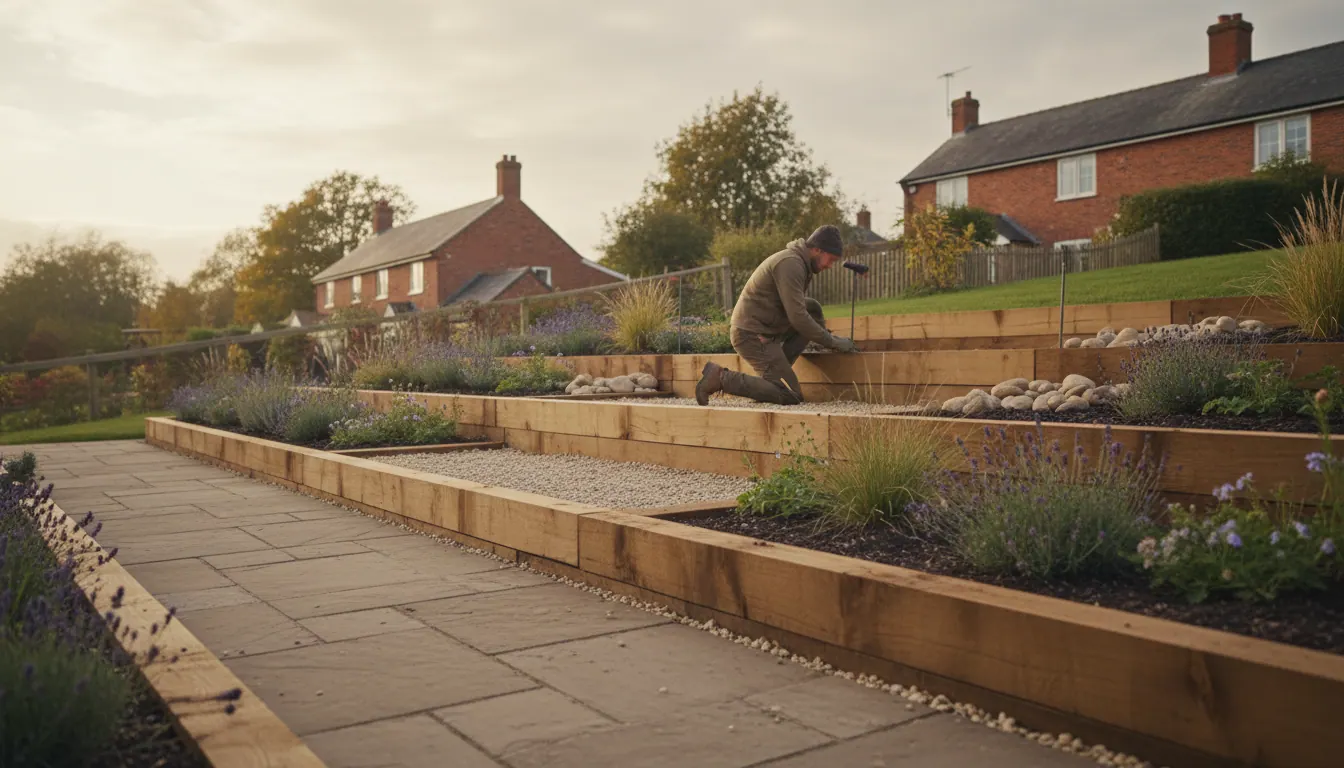
This is the more structured approach. You create a series of level tiers, each retained by a course (or more) of sleepers, with a step up between each level. It's well suited to steeper gardens, and it gives you genuinely flat planting beds that are easy to maintain and plant up.
The key challenge is getting each tier properly level, both along its length and across its width. On a slope, one end of the sleeper will always be sitting higher than the other until you've dug down to compensate. That digging is what takes the time.
Raked borders
On a gentler slope, you can sometimes run sleeper borders that follow the natural contour of the ground rather than fighting it. These look more informal, work well with naturalistic planting, and involve less excavation. They're not retaining in the same way, so they're better suited to edging and definition than to holding back significant amounts of soil.
For anything with a meaningful gradient, stepped terracing is almost always the better long-term answer. We've written more about the specific challenges of sloping ground and how we approach them in our article on bespoke garden fencing for sloping gardens in Winsford and Northwich, the same principles around post depth and ground movement apply equally to sleeper work.
Fixing Sleepers So They Actually Stay Put
This is where a lot of DIY sleeper projects fall down. The sleeper looks solid when it goes in. Six months later, the soil pressure behind it has pushed the front face forward and the whole thing looks untidy.
Sleepers need to be anchored, not just placed. The methods we use depend on the height of the retaining face:
- Single-course borders (up to about 150mm high). Timber stakes driven into the ground behind the sleeper and screwed through are usually sufficient. The stakes need to go deep enough to resist the soil load behind them.
- Two-course borders. The same principle applies, but the stakes need to be longer and the fixing more robust. Rebar driven through pre-drilled holes in the sleeper and into the ground below is a reliable method here.
- Three or more courses (significant retaining). At this height, the soil pressure is substantial. A proper foundation at the base, good drainage behind the wall, and through-bolted fixing between courses are all necessary. Corners need to be interlocked, not just butted.
Corners and joins matter too. Sleepers should be staggered in their courses, like brickwork, so vertical joints don't line up. This distributes the load and prevents weak points.
Drainage: The Thing People Forget
Water is the enemy of any timber retaining structure. If you trap moisture against the back of a sleeper wall without giving it anywhere to go, you're accelerating rot and building up hydrostatic pressure that will eventually push the structure forward.
On a sloping garden in Cheshire, where the soil is often clay-heavy and slow-draining, this matters a great deal. A layer of gravel or crushed stone behind the sleepers gives water a route downward. On longer retaining walls, weep holes at the base allow water to escape through the face of the wall rather than building up behind it.
It's also worth thinking about what you're planting. Dense, thirsty plants will draw moisture out of the soil behind the sleeper and reduce the pressure. Bare soil with no root structure holds more water and exerts more force.
What a Customer Said
We know that what homeowners really want from a joiner or carpenter is someone who turns up, does the job properly, and doesn't make a drama of it. Lisa Brookes put it well:
Polite very reliable and very good at what he does without stupid prices
That's the standard we work to, whether it's a single sleeper border in a Cuddington garden or a full tiered terrace on a steeply sloping plot in Weaverham.
Raised Beds vs. Retaining Borders: Which Do You Need?
These two things often get used interchangeably, but they're different in purpose.
A retaining border holds back existing ground. The soil behind it is at a higher level and the sleeper is doing structural work, resisting soil pressure.
A raised bed sits on top of existing ground and is filled with imported soil or compost. The sleeper is forming a container, not resisting anything.
On a sloping garden, you often end up with a combination. The lower courses of a tiered terrace are retaining; the upper courses form raised planting beds. Getting the distinction right affects how the structure is fixed and what's needed behind it.
We've covered the specifics of raised beds and sleeper borders on Cheshire's clay soil in more detail in our article on raised beds and sleeper borders on clay soil, worth a read if you're trying to work out which approach suits your garden.
Frequently Asked Questions
Can I use sleepers on a very steep slope in my Northwich garden? Yes, but the steeper the slope, the more important the engineering becomes. Very steep gradients may need multiple tiers rather than a single tall retaining wall. We always assess the slope in person before recommending an approach, because what works on a gentle incline in Davenham may not be appropriate on a sharper drop in Weaverham or Cuddington.
How deep should the foundations be for sleeper borders? It depends on the height of the retaining face. A single course sitting on firm, level ground may need only a shallow bed of compacted gravel. A two- or three-course retaining wall needs a proper base and, in clay soil, enough depth to get below the layer that moves most with seasonal moisture changes.
Do I need to treat sleepers before installation? Pressure-treated softwood sleepers come pre-treated, but the cut ends are exposed and benefit from an end-grain preservative. Oak sleepers are naturally durable and don't need treatment in the same way, though some people apply a finish for appearance. Reclaimed sleepers should be checked for creosote content before use near planting areas.
How long does it take to install sleeper borders on a sloping garden? It varies considerably depending on the size, the number of tiers and how much excavation is needed. A straightforward single-border job might take a day. A fully terraced garden with multiple levels, drainage and corner detailing is a multi-day project. We quote each job individually once we've seen the space and understood what's needed.
Ready to Sort Your Sloping Garden?
If your garden in Northwich, Winsford, Hartford, Sandiway, Barnton, Rudheath, Middlewich or anywhere nearby has a slope that's been frustrating you, sleeper borders done properly can transform it into something genuinely usable. We'd be glad to take a look and talk through what would work best for your particular plot.
Get in touch with us and we'll arrange a visit at a time that suits you.