Bespoke Garden Fencing for Sloping Gardens in Winsford & Northwich: How to Get Level Posts on Uneven Ground
Sloping garden? We fit timber fencing across Winsford, Northwich and the surrounding Cheshire villages. Here's how we tackle the gradient every time.

Sloping gardens are the norm around here, not the exception
Drive through Winsford, up towards Sandiway, or out past Cuddington and Weaverham, and you'll notice that very few gardens sit perfectly flat. Cheshire's mix of glacial clay, salt-subsidence land and gently rolling countryside means most plots have some kind of gradient. Some are a gentle lean. Others drop sharply from the house to the back boundary, or slope sideways across the plot. Either way, a standard fence panel does not simply follow the ground like a carpet. It needs a plan.
That is where a lot of homeowners run into trouble. A flat-pack panel from a builders' merchant is designed for level ground. Put it on a slope without adjusting the method, and you end up with triangular gaps at the base, panels that look uneven, or posts that lean because the footing was not set correctly for the angle. We see the results of rushed fence jobs every season, and the fix usually costs more than getting it right first time.
We are a joinery and fencing contractor covering Winsford, Northwich and the surrounding villages including Hartford, Davenham, Barnton, Moulton, Rudheath and Middlewich. Sloping garden fencing is one of the most common jobs we price up, so this article explains exactly how we approach it.
The two main methods: stepping versus raking
When we survey a sloping garden, the first decision is which fencing method suits the site. There are two fundamentally different approaches.
Stepped fencing keeps each panel horizontal and level. The panels step down the slope like stairs, with a triangular gap beneath each panel at the lower side. That gap is usually filled with a gravel board, an additional timber infill, or a combination of both. Stepped fencing gives a clean, structured look and works particularly well with close-board or feather-edge panels. It also makes future panel replacement straightforward because panels are standard sizes.
Raked (or sloped) fencing follows the gradient of the ground, so the top line of the fence runs parallel to the slope rather than in steps. This is harder to achieve with standard panels but works well with bespoke close-board fencing where the boards are cut to length individually. The result looks more fluid and suits gardens where the slope is gradual and consistent.
Which method is right depends on:
- How steep the slope is
- Whether the gradient is consistent or changes direction
- What the fence is for (privacy, boundary definition, keeping children or pets in)
- The style of the property and garden
On a plot in Winsford or Moulton with a sharp drop of a metre or more over the garden length, we would almost always recommend stepped close-board fencing with concrete gravel boards and morticed posts. On a gentler, consistent slope in Sandiway or Cuddington, raked feather-edge boarding often looks more natural.
Why the posts matter more than the panels
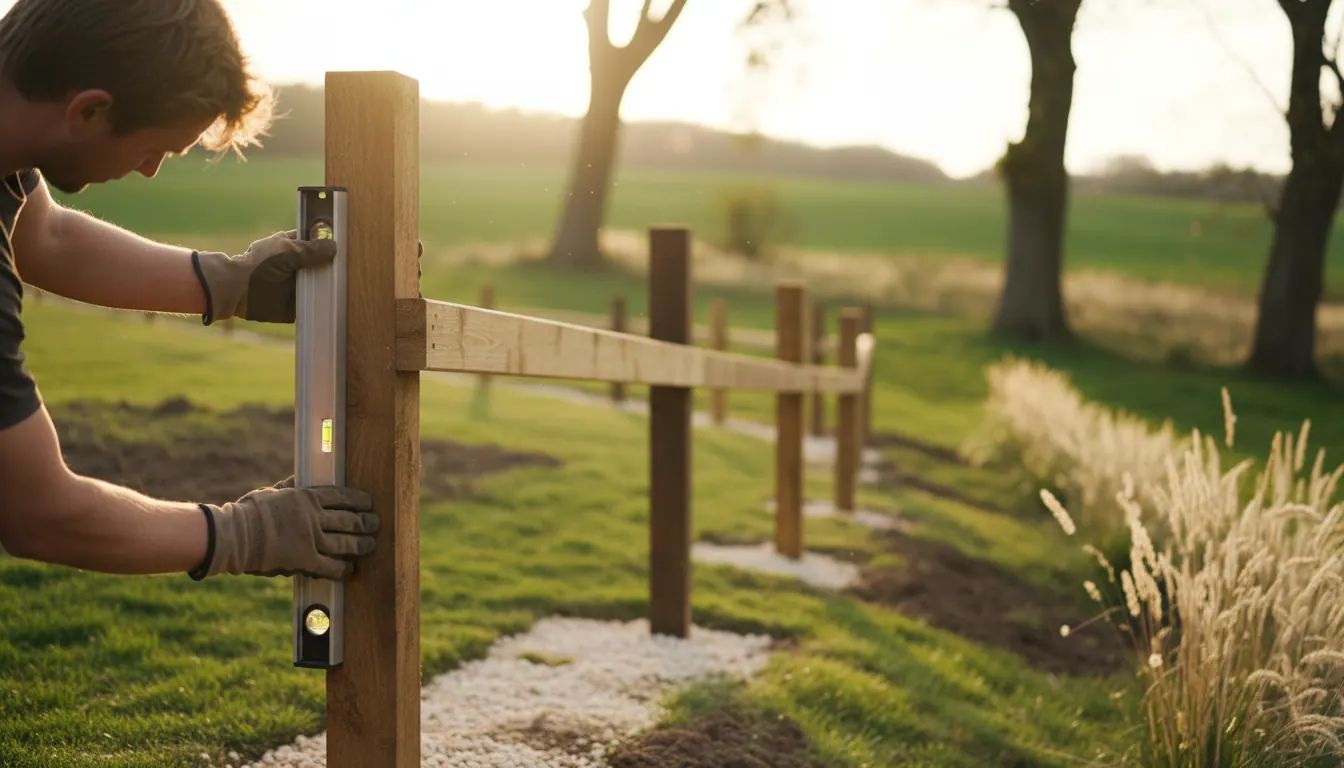
A fence is only as good as its posts. On sloping ground, this matters even more than on a flat site.
Posts need to be set at the correct depth regardless of the gradient. The general rule is that one third of the post length should be in the ground, but on sloping sites the effective loading on each post changes depending on its position on the slope. The uphill posts take different lateral loads to the downhill ones.
We use either concrete spurs or set posts directly in concrete depending on the ground conditions. Winsford sits over salt-bearing rock and the soil can be surprisingly variable, from firm clay to softer, more friable ground in areas affected by historical brine pumping. We check conditions as we dig and adjust accordingly. A post that looks solid on installation day but sits in soft ground will lean within a year.
Concrete gravel boards at the base are worth every penny on a sloping site. They protect the bottom of the fence from ground contact, allow the panels to be set correctly above the slope, and they last decades longer than a timber gravel board in contact with damp Cheshire soil.
What timber we use and why it matters outdoors
We work almost exclusively in timber for garden fencing. Pressure-treated softwood is the standard for fence posts, rails and feather-edge boards. The treatment drives preservative deep into the grain, giving protection against rot and insect damage without needing regular re-treatment.
For close-board and feather-edge fencing, we use sawn softwood boards that are rough-sawn on the back face and smooth on the face side. The overlap between boards means even as individual boards shrink slightly in dry weather, the fence maintains its privacy.
Hardwood posts and rails are available for premium installations, particularly where a fence adjoins decking, a pergola or a gate. They are more expensive but noticeably more durable and they take a finish well if you want to stain or oil the timber.
We do not fit composite or metal panel fencing. Our expertise is timber, and we think it is the right material for most Cheshire gardens, both visually and practically.
Heights, planning and the 2m rule
One question that comes up on almost every fencing job is height. The rules in England are straightforward but worth knowing before you decide what you want.
You can erect a fence up to 2 metres in height at the rear of your property without needing planning permission. For a fence fronting a road or footpath, the limit is 1 metre. These limits apply to the total height of the fence including any trellis on top.
On sloping ground, height is measured from the ground level on the higher side. So if your garden steps down and you want consistent 1.8m privacy panels along the boundary, the panels on the lower side of each step will appear taller from the neighbour's garden. Worth considering when you are planning the job with your neighbours.
If you are in a conservation area, or if your property has a restrictive covenant (which some newer Winsford and Northwich developments do), the rules may differ. We always recommend checking with Cheshire West and Chester Council if there is any doubt before we start work.
What affects the cost of garden fencing on a slope?
Garden fencing on sloping ground costs more than a straight run on a flat site. That is simply honest. The reasons are:
- More time setting out and measuring the gradient
- Additional materials for gravel boards and infill at the base of each step
- Deeper or more carefully positioned post holes
- More cutting and fitting on site
The overall cost depends on the length of the run, the height of the fence, the number of direction changes or corners, whether there are existing posts to remove, and the access to the garden (we have dug post holes in Weaverham back gardens that were only reachable through the house).
We do not publish a fixed price per metre because every sloping site is different. What we do is come out, walk the boundary, measure the drop and give you a written quote. No obligation, no pressure.
If you want a rough sense of scale before we visit, our article on fence repairs versus replacement in Winsford covers how we think about cost and value when fences are coming to the end of their life.
Timing: why autumn is actually a good time to book a new fence
A lot of homeowners wait until spring to think about the garden. But autumn and early winter are genuinely good times to have a fence replaced in Cheshire. The ground is still workable before the hard frosts, the timber can settle over winter before the growing season puts pressure on it, and lead times are shorter because demand is lower.
If a storm has already taken down panels or shifted posts, we can usually assess the damage quickly and advise whether a repair will hold or whether a full replacement is the better call. Our article on storm-damaged fences in Cheshire covers exactly that decision in more detail.
Frequently asked questions
What is the maximum fence height allowed on sloping ground in the UK?
At the rear of a residential property, you can build a fence up to 2 metres high without planning permission. For a fence bordering a highway, the limit is 1 metre. On sloping ground, height is measured from the higher ground level. If you are unsure about your specific site, it is always worth a quick check with Cheshire West and Chester Council before work begins.
What is the most affordable option for a garden fence on a slope?
Pressure-treated feather-edge close-board fencing is generally the most cost-effective timber option for sloping ground. It can be raked to follow a gentle gradient, or stepped with gravel board infills on steeper sites. It is durable, looks good and is straightforward to repair if a board is damaged years down the line. We would always recommend pressure-treated timber over untreated, even on a tight budget, because it lasts far longer.
Why do quotes for garden fencing vary so much?
The difference usually comes down to materials, method and what is included. A very low quote may mean untreated timber, shallow post holes, no concrete, or panels that are not suited to the slope. We use pressure-treated posts set in concrete, concrete gravel boards on sloping sites, and properly morticed rails. The job takes longer done properly, but the fence lasts a decade or more rather than starting to lean within two or three years.
Do I need my neighbour's agreement before replacing a boundary fence?
If the fence sits on your boundary and you are replacing it like for like, you generally do not need permission. If you are changing the height, style or position, it is courteous and often sensible to discuss it with your neighbour first. Boundary disputes are a common source of friction, and a quick conversation before work starts avoids most of them.
Get in touch about your sloping garden
If you have a sloping garden in Winsford, Northwich or any of the surrounding villages and you want a fence that is built to last, we are happy to come out and take a look. No hard sell, just a straight conversation about what will work and what it will cost.
Get in touch with us here and we will arrange a convenient time to visit.