Storm-Damaged Fences in Cheshire: When to Repair, When to Replace
Storm damaged your fence in Cheshire? We cover repairs, replacements, responsibility and what to expect from a local fencing contractor in Winsford & Northwich.

When a Cheshire Storm Takes Out Your Fence
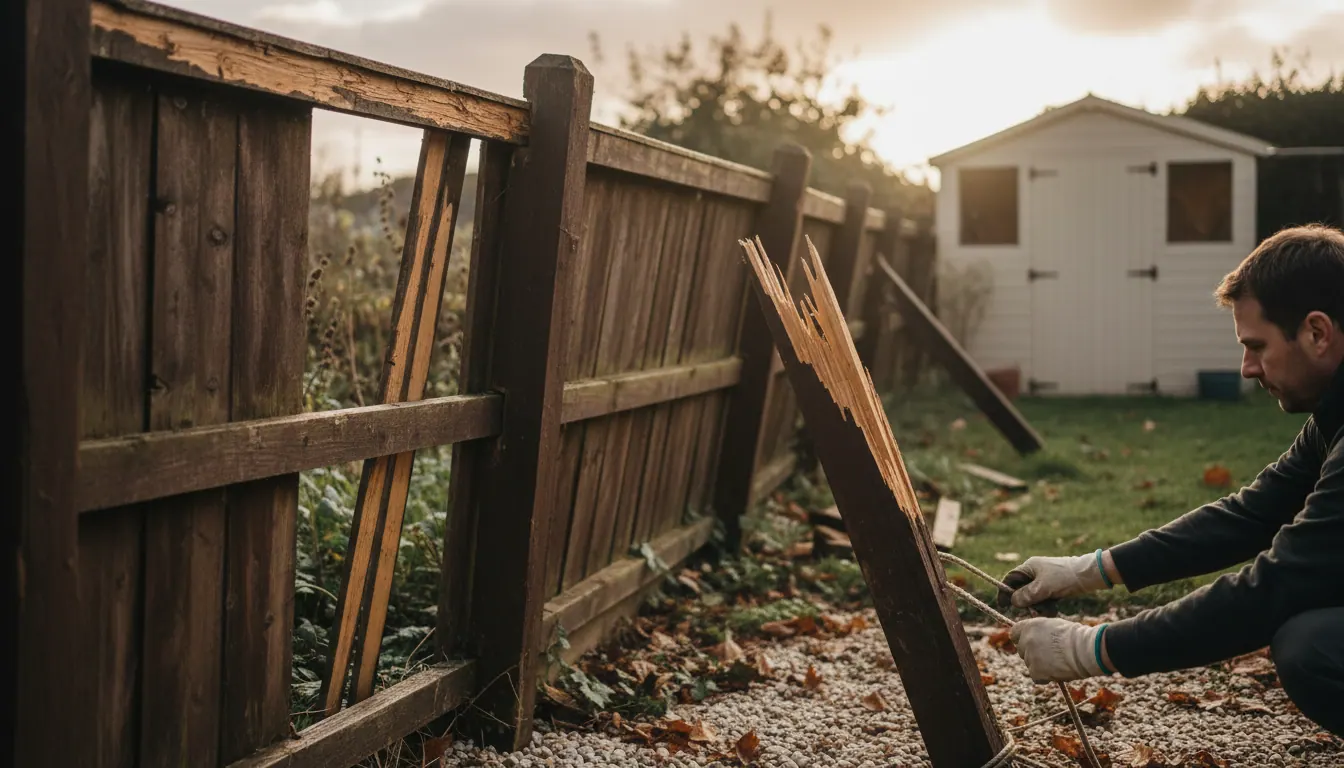
A decent storm can flatten a fence in minutes. One morning you draw the curtains and there it is: panels down, posts snapped at ground level, the whole run leaning into next door's garden. It happens every winter across Winsford, Northwich, Hartford, Weaverham and the surrounding villages, and it always seems to happen on a Sunday.
The first question most people ask is not "how do I fix it?" It's "whose job is it to fix it?"
That's a fair question, and the answer is more nuanced than most people expect. This article walks you through the practicalities: who is responsible, what a proper repair actually involves, and when a repair is worth doing versus when a full replacement makes more sense.
Who Is Responsible for a Storm Damaged Fence?
This is the question that causes the most friction between neighbours, and the honest answer is: it depends on your deeds.
Your title deeds (or the conveyancing documents from when you bought the house) should show a "T" mark on the boundary plan. Whichever side the T is on, that owner is responsible for maintaining that boundary. In many Cheshire properties, particularly the older semis and terraces around Northwich and Winsford, the T marks are not always clear or consistent. Sometimes there is no T at all.
A few things worth knowing:
- No law forces a homeowner to repair or maintain a boundary fence. There is no general legal obligation in England and Wales. Your deeds may create a covenant, but the law itself does not.
- Your neighbour is not automatically obligated to repair their fence, even if it has blown onto your garden. Unless their deeds say otherwise, they are not breaking any law by leaving it down.
- If your neighbour's fence fell because it was already rotten or poorly maintained, and that caused damage to your property, you may have a civil claim. But that is a legal matter, not a fencing one.
- Your home insurance may cover storm damage to fences on your boundary. Check your policy carefully. Many policies cover it under buildings or contents, though some exclude fencing or cap the payout.
The practical upshot: if you want the fence fixed quickly and properly, it is often easier to just sort it yourself and have that conversation with your neighbour afterwards, especially if the boundary is shared.
Repair or Replace? How to Make the Right Call
Not every storm-damaged fence needs a full replacement. But not every repair is worth the money either.
Here is how we tend to assess it on site:
Worth repairing:
- One or two panels blown out but the posts are still solid
- A gate that has dropped or a hinge that has given way
- A gravel board that has cracked but the post and panel are intact
- Minor panel damage where the frame is still sound
Worth replacing:
- Posts that have snapped at or below ground level (this usually means the timber was already rotten)
- Multiple panels down across a long run
- A fence that was already at the end of its life before the storm hit
- Concrete spurs that have cracked or shifted
The honest truth is that a storm rarely destroys a fence that was in good health. It tends to expose the weak points: a post that was already soft at the base, a panel that had been holding on for a couple of years longer than it should. If we come out and find that the posts are sound, we will tell you. If we find that the posts are the real problem, we will tell you that too, because replacing panels on rotten posts is money wasted.
What a Proper Storm Damage Repair Actually Involves
This is where cutting corners causes problems later. We see it regularly across Winsford, Rudheath, Barnton and Middlewich: a fence that was "repaired" after a storm but failed again the following winter because the root cause was never dealt with.
A proper repair means:
- Assessing every post along the affected run, not just the ones that obviously snapped. We check for soft timber at ground level and test for movement.
- Removing old posts correctly. A post driven or concreted into the ground needs to come out cleanly. Leaving a rotted stump in and bolting a new post to it is a temporary fix at best.
- Setting new posts properly. We use post mix concrete and allow it to cure before loading the fence. On sloping gardens (common in Cuddington, Sandiway and the hillier parts of Weaverham), the post depths and heights need adjusting to follow the ground properly.
- Matching materials where possible. If you have close-board fencing, we replace with close-board. If you have feather-edge, we match the profile and height. We do not mix panel styles unless you want us to.
- Gravel boards. These are often missed. A gravel board lifts the panel off the ground and takes the moisture hit instead of the panel itself. Replacing them at the same time as the panels is good practice and extends the life of the whole fence significantly.
Fencing in Cheshire: Why the Local Conditions Matter
Cheshire weather is not gentle. The area sits in a bit of a corridor for westerly and south-westerly winds, and when a storm tracks up from the Irish Sea, fences along exposed runs take a battering. Gardens backing onto open fields around Davenham, Moulton and the edges of Winsford are particularly exposed.
The other local factor is soil. Clay-heavy ground, which is common across much of the Cheshire Plain, does not grip fence posts as firmly as sandy or stony ground. Posts can rock over time, and once they start to move, the fence is gradually weakening even if it looks fine on the surface. This is one of the reasons we always check post stability as part of any storm repair job.
Older housing stock across Northwich and Winsford often has shorter fence lines with multiple changes of direction, awkward corners, and boundaries that do not run in a straight line. That usually means a bespoke approach rather than just ordering a set number of standard panels.
Bespoke Timber Gates After Storm Damage
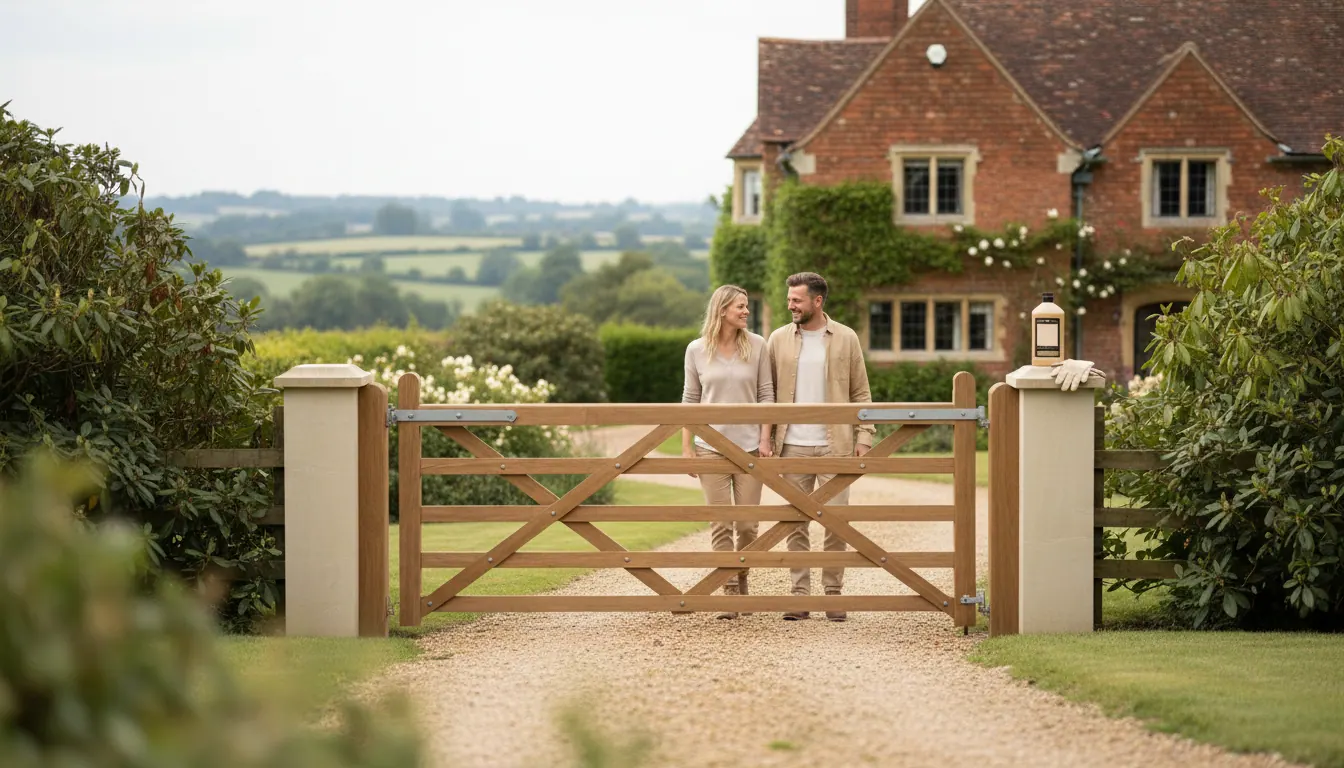
Sometimes a storm takes out a gate as well as the fence. If your gate was a standard panel-and-frame affair that has seen better days, it might be the right moment to replace it with something better.
We make bespoke timber gates to measure, which means the gate actually fits the opening properly, swings cleanly, and latches without lifting. Standard off-the-shelf gates rarely fit older openings well, and a gate that drags or drops is a nuisance from day one. A made-to-measure gate, hung on good hardware, should give you many years of trouble-free use.
Frequently Asked Questions
Is my neighbour legally obligated to repair their fence?
In most cases, no. There is no general law in England and Wales requiring a homeowner to maintain a boundary fence. The obligation, if one exists, will be written into the title deeds as a covenant. If there is no such covenant, your neighbour is not breaking any law by leaving a damaged fence down. It is worth checking your deeds, but do not assume the law is on your side without doing so.
Who is responsible for a storm damaged fence in Cheshire?
Responsibility is determined by your property deeds, specifically the boundary plan showing T marks. The owner on whose side the T falls is responsible for that boundary. Where deeds are unclear, responsibility is often shared informally or by agreement. Your home insurance is also worth checking, as some policies cover storm damage to boundary fencing.
What can I do if a neighbour's damaged fence has fallen onto my property?
Start with a friendly conversation. If the fence was already in poor condition before the storm, you may have grounds for a civil claim if it caused damage to your property or garden. In practice, most boundary disputes like this are resolved by agreement rather than legal action. If you want the fence sorted quickly, it may be more practical to handle the repair yourself and discuss the cost with your neighbour afterwards.
How do fencing contractors charge for storm damage repairs?
Every job is different, which is why we quote after seeing the site rather than giving a standard day rate over the phone. The scope varies enormously: a single snapped post and a couple of panels is a very different job from a full run that needs new posts, gravel boards and panels along a sloping boundary. We welcome single-panel and small-repair jobs, not just full replacements. The best way to get an accurate figure is to get in touch and we will come and have a look.
Get Your Fence Sorted Before the Next Storm
If your fence has come down or is looking shaky after recent weather, now is the right time to deal with it. Leaving a weakened fence over winter almost always means more damage and more cost in the spring.
We cover Winsford, Northwich, Hartford, Davenham, Sandiway, Weaverham, Cuddington, Moulton, Barnton, Rudheath and Middlewich. We are happy to look at jobs of all sizes, from a single dropped panel to a full boundary replacement.
If you are also thinking about indoor joinery work while we are there, we have written about fitting doors properly to eliminate draughts and misalignment and why alcove units in Winsford and Northwich need a made-to-measure approach if either is useful.
To arrange a visit or ask a question, get in touch with us and we will get back to you promptly.