Rotten Fence Posts in Winsford & Middlewich: Spotting Decay Before It Fails & When to Replace
Rotten fence posts in Winsford or Northwich? We explain what causes rot, how to spot it early, and when repair or replacement is the right call.

Rotten fence posts: the problem that gets worse the longer you leave it
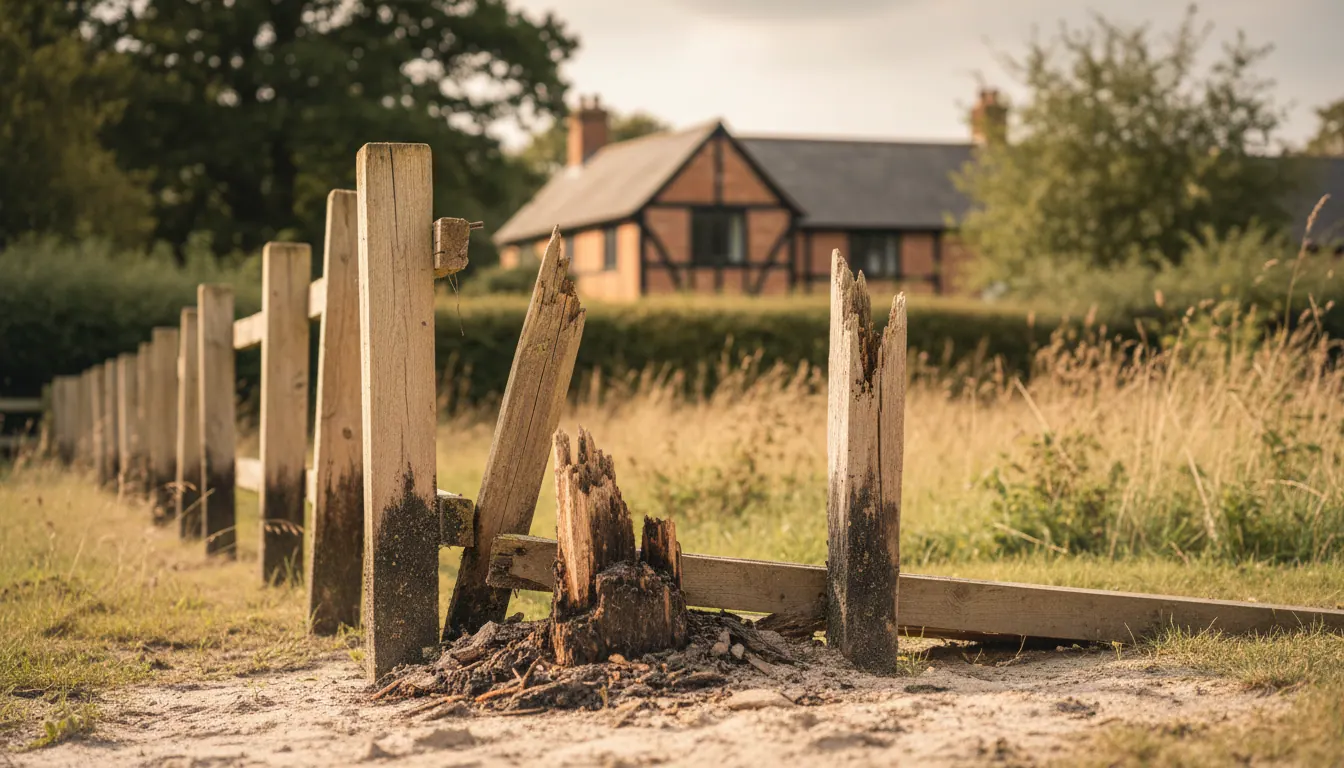
A fence post does not rot overnight. It happens slowly, usually at ground level where the timber sits in damp soil, and by the time the fence starts leaning you have often already lost the battle at the base. Across Winsford, Northwich and the surrounding villages, we see this constantly, particularly after a wet Cheshire winter. The ground stays saturated for months, and untreated or ageing timber simply cannot cope with that sustained moisture.
The good news is that catching rot early gives you options. Leave it too long and you are looking at a full replacement. Act sooner and a targeted repair can sort the problem without pulling down an otherwise sound fence.
Why fence posts rot at ground level
Timber rots because of fungal decay, and fungal decay needs moisture and oxygen to thrive. The ground-line is the worst possible place for a fence post because it offers both in abundance. Rain soaks down, the soil holds it, and the timber sits in that wet environment day after day.
A few specific things make it worse:
- Softwood posts without proper treatment. Untreated or poorly treated softwood absorbs moisture readily. Many older fences in Winsford and Northwich were put up with posts that have simply reached the end of their useful life.
- Concrete that has cracked or lifted. When the concrete collar around a post cracks, it channels water straight down to the base rather than shedding it away.
- Gravel boards that have failed. A gravel board is supposed to take the ground-level punishment so the post does not have to. If the gravel board has rotted or been knocked out of position, the post takes the hit instead.
- Panels sitting in standing water. Gardens in Weaverham, Cuddington and Sandiway often have low-lying areas that pool after heavy rain. Fences in those spots age faster.
- Previous repairs that trapped moisture. A post that has been patched or bolted to a repair spur without addressing the wet conditions underneath will just rot again.
How to tell if your post is rotten
You do not always need a professional to tell you a post is in trouble. Here are the things to check:
Push the post by hand. A sound post set in concrete should not move at all. If there is any flex or wobble, especially at ground level, the base has likely gone.
Check the colour and texture at ground level. Healthy treated timber is dense and consistent in colour. Rotten timber looks darker, often almost black, and feels soft or spongy when you press a screwdriver or key into it. If the tool sinks in easily, the rot is already significant.
Look at the fence line from a distance. A leaning or bowing run of panels is almost always a post problem. Panels themselves rarely cause a lean; the post is the structural element.
Check where the post meets the concrete. This junction is the highest-risk zone. If the concrete collar has cracked and pulled away, water is getting in at exactly the wrong spot.
If you are unsure, get in touch with us and we can take a look. We cover Winsford, Northwich and all the surrounding villages including Hartford, Davenham, Barnton, Rudheath and Middlewich.
Repair or replace? What actually makes sense
This is the question we get asked most often, and the honest answer is that it depends on how far the rot has gone and what condition the rest of the fence is in.
When a repair makes sense:
- The rot is confined to one or two posts and the panels, rails and gravel boards are otherwise sound.
- The post is rotten at the base but the upper section is still solid.
- The fence is relatively new and the posts are the only failing element.
In these cases, a repair spur (sometimes called a post repair spur or post support spike) can be concreted in alongside the existing post, with the two bolted together. Done properly, this is a strong and lasting fix. We use metal repair spurs rather than timber ones because they do not rot, and we set them in fresh concrete to give a solid base.
When replacement is the better call:
- Multiple posts are affected and the fence is showing widespread deterioration.
- The panels are also rotten, split or warped.
- The fence is more than fifteen years old and showing its age throughout.
- The rot has travelled well above ground level into the main body of the post.
Replacing a run of fence is a bigger job but it is worth doing properly rather than patching repeatedly. We can remove old fencing and fit new posts, panels and gravel boards to a proper standard. If your garden slopes, that brings its own challenges around keeping posts level and managing the step-down between panels. We have written about that in detail in our article on bespoke garden fencing for sloping gardens in Winsford and Northwich.
For a broader look at when storm damage tips the balance towards full replacement, see our post on storm-damaged fences in Cheshire: when to repair, when to replace.
What the repair process actually looks like
If you have not had fence post work done before, here is a straightforward account of what we do on a typical rotten post repair in Winsford or Northwich.
- Assess the extent of the rot. We check every post in the run, not just the obvious ones, because rot in one often signals problems developing in neighbours.
- Remove any panels or gravel boards needed to access the post base. We do this carefully so sound panels can be refitted rather than wasted.
- Dig out around the post base. This lets us see exactly how far the rot has gone and whether the existing concrete collar is intact.
- Fit the repair spur. We position a galvanised steel repair spur alongside the post, set it in new concrete, and allow it to cure properly before loading the fence back onto it.
- Refit or replace gravel boards. Gravel boards are the first line of defence at ground level. If they are gone or rotten, we replace them at the same time.
- Refit panels and check the fence line. Everything goes back level and properly fastened.
The result is a fence that sits solidly again without the cost of a full replacement.
What our customers say
We quoted one job recently and were told the price was fair and the work was exactly what was needed. That kind of feedback matters to us. Lisa Brookes, who had work done with us, put it simply:
Polite very reliable and very good at what he does without stupid prices
That is the standard we aim for on every job, whether it is a single rotten post in Moulton or a full fence replacement in Barnton.
Frequently asked questions
Can I repair a rotten fence post myself?
You can, and some people do. The challenge is getting the repair spur set truly vertical and allowing the concrete to cure fully before the fence takes any load. A post that is set slightly out of plumb will cause the fence line to drift over time. If you are confident with post work and have the right tools, a DIY repair spur job is achievable. If you are not sure, it is worth getting a professional in, because a poorly set repair spur can fail within a season.
How long does a fence post repair last?
A properly installed galvanised steel repair spur set in fresh concrete should last many years. The original post above ground level will continue to age, so at some point the post itself may need replacing even if the base repair holds. Keeping gravel boards in good condition and making sure panels are not holding standing water against the post will extend the life of the repair significantly.
My fence is leaning but I can't see obvious rot. What else could cause it?
A few things. The original post may have been set without concrete or in very shallow concrete, so it has simply worked loose over time. The concrete collar may have heaved due to frost, which is not uncommon in Cheshire after a hard winter. Or the post may be rotten deep underground where you cannot see it from the surface. A wobble at the base almost always means the fixing to the ground has failed, whether through rot, inadequate original installation or frost movement.
Do you take on single-post jobs or do you only do full fence replacements?
We take on single-post jobs. We are not a large contractor that only wants big runs. If you have one rotten post causing a section of fence to lean in Davenham, Rudheath or anywhere else in our area, that is a job we are happy to look at. We would rather help you sort a small problem before it becomes a large one.
Get in touch
If you have a leaning fence, a post that moves when you push it, or gravel boards that have rotted away at ground level, we can help. We cover Winsford, Northwich and the surrounding villages across Cheshire. Get in touch with us and we will come out, have a look, and give you a straight quote for what the job actually needs.