Garden Screening & Privacy Fencing in Weaverham & Cuddington: Bespoke Timber Solutions for Overlooked Gardens
Need garden screening or privacy fencing in Weaverham or Cuddington? We build bespoke timber solutions for Cheshire gardens. Get in touch for a free quote.

Why Garden Screening Matters More in Weaverham and Cuddington Than You Might Think
Gardens in Weaverham and Cuddington tend to sit close together. The housing mix here runs from post-war semis and bungalows to newer estates where the plots are generous but the gaps between them are not. Add in the fact that the Cheshire plain is flat and open, with precious little natural shelter, and you quickly understand why garden screening is one of the most common jobs we get called out to do in this part of the county.
Privacy fencing is not just about keeping neighbours from seeing your garden furniture. It is about making your outdoor space feel like it belongs to you. A well-built timber screen gives you that feeling without making the garden feel like a prison yard.
What We Mean by Garden Screening (and What We Do Not Mean)
There is a difference between a standard close-board fence panel and a proper garden screen. Standard panels are boundary markers. They go up, they do a job, and they are fine for that. But garden screening is something more considered. It might be:
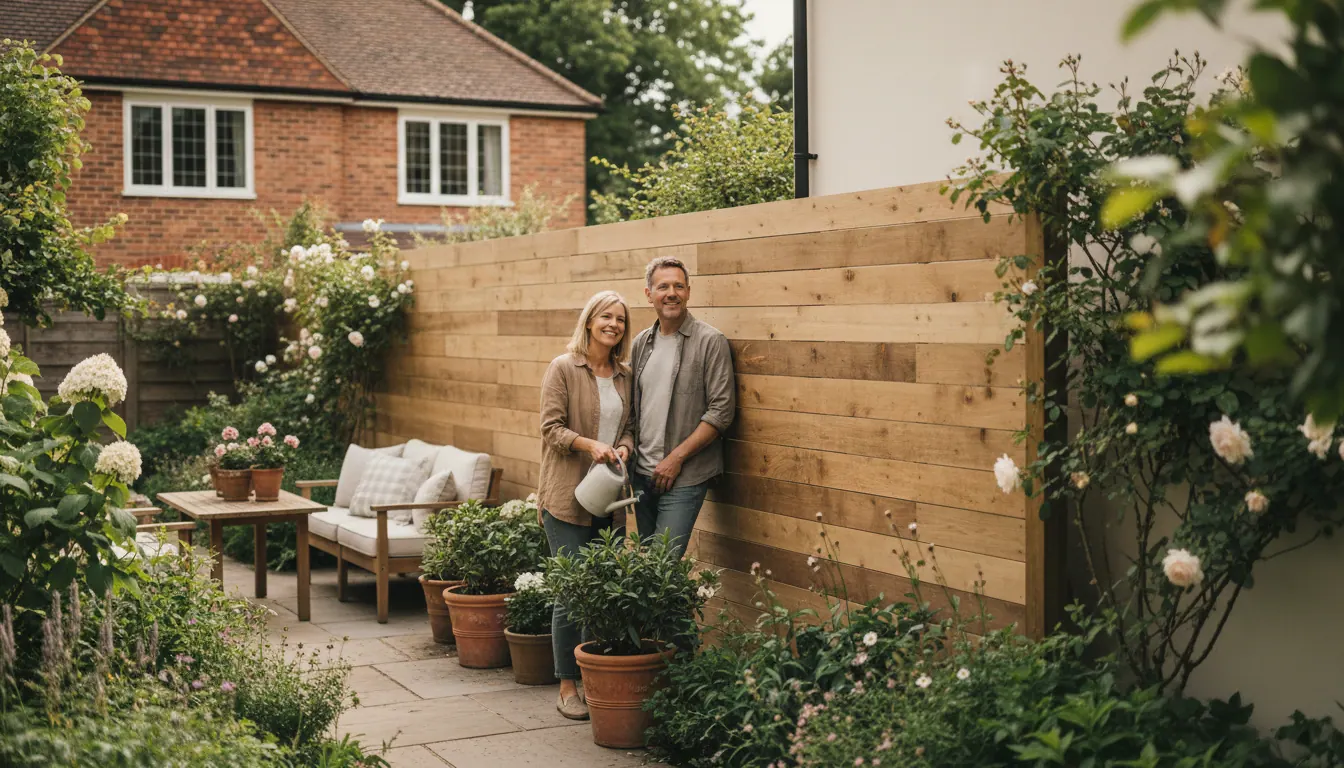
- A slatted timber frame fixed to an existing wall or fence post, letting light through while blocking sightlines
- A full-height privacy panel built to a specific height and position, angled to block a particular window or first-floor viewpoint
- A pergola with side panels that create a screened seating area
- Trellis-topped fencing that adds height where a solid panel would look oppressive
- A combination of close-board and open-slatted sections, so air moves through but visibility is restricted
We design each screen around what you actually need it to do, not around what a catalogue says is available. That is the whole point of coming to a local joiner rather than ordering flat-pack panels from a builder's merchant.
The Weaverham and Cuddington Garden Challenges We See Most Often
Every area has its quirks. In Weaverham and Cuddington, the jobs we get called to most often share a few common threads.
Overlooked rear gardens. A lot of properties in this area have neighbours with raised ground levels, or houses that are slightly staggered, meaning a standard 1.8-metre fence does nothing for privacy when someone's kitchen window looks straight into your patio. We can design screening that targets that specific sightline without blocking your own light.
Wind. The Cheshire plain catches the wind badly. A solid screen that is not properly engineered will act like a sail. We use gravel boards, concrete spurs or concrete posts at the base, and we build in enough structural integrity that the screen does not rock in a January gale. Slatted designs also help here because they let wind pass through rather than resist it.
Sloping gardens. Cuddington in particular has some gardens that drop away from the house, and getting a screen to look right on uneven ground takes thought. We can step the panels, rake them to follow the slope, or use adjustable post depths to keep the top line level. For more on how we approach this, our article on bespoke garden fencing for sloping gardens in Winsford and Northwich goes into the detail.
Damp ground. Clay soil is widespread across mid-Cheshire. Posts set into clay-heavy ground hold moisture around the base, which is where rot starts. We address this with the right post treatment, proper post depth, and concrete collars or spurs where the ground conditions call for it.
Timber Is Still the Right Material for Most Weaverham Gardens
There is a lot of noise about composite and metal screening at the moment. Both have their place. But for most residential gardens in Weaverham and Cuddington, timber remains the right call, and here is why.
Timber looks right in a Cheshire garden. It weathers in a way that feels natural rather than looking like a product. It can be cut, shaped and fixed to fit the exact dimensions of your space. And when a section is damaged, it can be repaired rather than replaced wholesale.
The key is using the right timber in the right way. Pressure-treated softwood is the standard for fence posts and panels. Hardwood is worth considering for slatted screens and decorative features where grain and finish matter. We will tell you honestly which material suits your job.
One thing that makes a real difference to longevity is the base. Gravel boards at the bottom of a panel keep the timber off the soil, which is where damp attack starts. Our article on gravel boards and fence bases in Winsford explains this in more detail, but the short version is: a gravel board can add years to the life of a fence or screen.
Privacy Fencing vs Garden Screening: Knowing Which One You Need
People use these terms interchangeably, but they describe slightly different things.
Privacy fencing is a boundary or near-boundary structure. Its main job is to define your plot and stop people seeing in. It is typically 1.8 metres tall, close-boarded, and built along the full length of a boundary.
Garden screening is more targeted. It might be a single panel positioned to block one specific viewpoint. It might be a three-sided enclosure around a hot tub or seating area. It might be a pergola with infill panels on two sides. It does not have to run the full length of your garden.
In practice, a lot of jobs involve both: a new boundary fence with a specific screening feature built in at the seating end, for example. We can design and build both as part of a single project.
What One of Our Customers Said
Polite very reliable and very good at what he does without stupid prices
Lisa Brookes
We get a lot of enquiries from people who have had experiences with contractors who turn up late, quote vaguely and then disappear. We take reliability seriously. When we say we are coming, we come. When we quote, we quote properly. That is just how we work.
Garden Structures That Go Beyond a Plain Fence
If you are already thinking about screening, it is worth considering whether a slightly larger garden structure would serve you better. A pergola with side panels gives you shade, privacy and a defined outdoor room all in one. A bin store built to match your fence keeps things tidy without looking like an afterthought.
We build all of these as bespoke timber structures, sized and positioned to fit your garden rather than a standard catalogue dimension. Our article on garden structures in Cheshire, including pergolas, screening and bin stores covers the range of options in more detail.
Planning Permission: What You Need to Know
Most garden screening and fencing in Weaverham and Cuddington falls within permitted development. The general rule is that fences and screens up to 2 metres high on a boundary do not need planning permission, and structures under 1 metre high adjacent to a highway are also permitted.
There are exceptions. If your property is in a conservation area, if it is a listed building, or if there are conditions on your planning consent that restrict boundary structures, you may need to check with Cheshire West and Chester Council before we start. We will flag anything that looks like it might need checking when we come to look at the job.
Frequently Asked Questions
Can you build garden screening in Weaverham or Cuddington without replacing my whole fence?
Yes. A lot of our screening jobs are standalone structures that sit in front of or alongside an existing fence. If your boundary fence is still sound, there is no reason to replace it just to add a screen. We can fix a new slatted panel or privacy section to existing posts, or set new posts in the positions that give you the sightline cover you need.
How tall can a garden screen be before I need planning permission?
As a general guide, boundary structures up to 2 metres do not require planning permission for most residential properties. If your property is in a conservation area or has planning conditions attached, the rules may be different. We always recommend checking with Cheshire West and Chester Council if there is any doubt.
What timber is best for a garden screen that will last in the Cheshire climate?
Pressure-treated softwood is the practical choice for most screens and fence posts. It handles the wet Cheshire winters well, and modern treatment processes mean the protection goes deep into the timber rather than sitting on the surface. For slatted or decorative panels where appearance matters, we sometimes use hardwood. We will recommend the right material when we come to look at the job.
Can you fix a screen to a wall rather than digging new posts?
Yes, in many cases. Wall-fixed timber frames are a good option where you want a screen against a house wall or an existing brick boundary wall. The fixing method depends on the wall construction, but it is a straightforward job for most masonry walls. It avoids disturbing the ground, which matters in gardens where drainage or underground services are a consideration.
Ready to Talk About Your Garden?
If you are in Weaverham, Cuddington, or anywhere across our patch including Northwich, Sandiway, Hartford, Barnton, Davenham, Rudheath, Moulton, Winsford or Middlewich, we are happy to come and have a look at what you have in mind. We quote each job properly once we have seen the space. No guessing, no vague ballparks.
Get in touch with us and we will arrange a time that suits you.